
Key Takeaways
- Feature checklists can create false equivalence between platforms with fundamentally different workflows, so evaluation frameworks built around workflow tend to hold up better.
- The proposal process begins with data intake. Platforms that automate statement extraction from multiple custodians can meaningfully reduce manual entry and error surface.
- Embedded portfolio analytics tend to be a defining capability. When advisors need to export data to a separate tool for analysis, the workflow often develops gaps.
- Governance works best when it is architectural rather than a final review step. Template-level controls and audit trails support consistency at scale.
- Firm size and structure often shape which capabilities matter most. A solo RIA generally prioritizes a repeatable path from data to presentation, while an enterprise firm typically prioritizes firmwide consistency and oversight.
An advisory firm sits down to evaluate a new piece of wealth management proposal software. The process begins, as it often does, with a spreadsheet. Rows fill up with features: white-labeled templates, portfolio analytics, CRM integrations, compliance checkboxes. Three vendors give impressive demos, and each one checks nearly every box. A decision is made.
Six months later, the friction becomes clear. Advisors are spending an hour manually keying in holdings from prospect statements before the "automated" proposal workflow can even begin. The analytics in the final report are screenshots pasted from a separate risk tool. And the compliance team has limited visibility into whether every advisor is using the latest disclosure language. The feature list matched; the firm's actual workflow did not.
This scenario is common because most evaluations start from a flawed premise. They treat proposal generation as a feature decision when it is fundamentally a workflow decision.
Why Proposal Software Evaluations Often Start With the Wrong Question
Feature checklists can create a false equivalence between platforms that operate at different points in the advisory workflow. Consider a multi-office RIA scoring four platforms on a 47-item checklist and ending with a three-way tie. The tie may only break when the firm asks each vendor to demonstrate the complete process, from receiving a prospect's brokerage statement to delivering a branded comparison report with the appropriate internal review.
Two of the four platforms might require data to be exported, analyzed in a separate tool, and then reintroduced into the proposal builder. On paper, all platforms may show "portfolio analytics" and "CRM integration." In practice, those architectural differences can add meaningful time and coordination steps to each proposal.
The evaluation error is treating proposal generation as an isolated output step. A workflow-oriented approach looks across the broader acquisition process: data intake, analysis, construction, presentation, governance, and the handoff into the next stage of the client journey. A more useful first question is often not "What features does this tool have?" but "Where does this tool sit in our workflow, and what happens upstream and downstream of it?"
Many tools listed in industry roundups are actually portfolio management platforms, financial planning engines, or CRM add-ons where proposal generation is a secondary capability. Financial planning engines and CRMs serve important purposes, but they occupy different positions in the tech stack. Conflating them with dedicated wealth management proposal software, or with broader acquisition workflow infrastructure, can lead to misaligned expectations and avoidable process gaps.
Read more: How to Create Winning Proposals: 3 Tips for Advisors
Five Workflow Capabilities That Separate Proposal Software from Presentation Tools
Instead of relying on a feature list alone, firms may benefit from evaluating wealth management proposal software through a workflow framework. These five capabilities, organized into three stages, can help reveal whether a platform mainly generates documents or supports the broader work required to move from raw data to a client-ready deliverable. The distinction matters because proposal generation is often only one component of a larger acquisition workflow.
Data Intake: Statement Extraction and Multi-Custodian Consolidation
The proposal workflow begins not when an advisor opens a template, but when client data enters the system. One consequential capability is whether the platform can ingest investment statements across multiple custodians and account types and structure that data with limited manual entry.
Consider an advisor meeting a prospect who holds accounts at two different brokerage firms and has a held-away 401(k). If the advisor manually keys in dozens of line items from three PDF statements, the risk of transcription error can grow and the time cost can add up. A workflow-oriented platform may use automated statement extraction to convert PDFs into structured, analyzable data more efficiently.
When evaluating, firms should assess whether the platform reconciles extracted data against statement summaries, handles multi-account and multi-custodian data streams, and includes held-away asset logic. When a platform cannot incorporate assets it does not custody, the resulting proposal may reflect an incomplete view of the prospect's broader portfolio. Data intake quality can shape everything that follows.
Analysis and Construction: Embedded Analytics vs. Bolted-On Reporting
The next stage, where raw data becomes usable insight, is where proposal tools often show meaningful differences. Some platforms generate a proposal document but rely on the advisor to perform analysis elsewhere, whether in a dedicated analytics tool, a separate risk system, or a spreadsheet. The advisor then pastes those outputs or screenshots into the proposal. This can create a disconnected workflow where the analysis and the deliverable are not structurally linked, which may make updates more tedious and introduce versioning challenges.
Other platforms embed analytics directly within the proposal construction environment. This may include performance attribution, risk decomposition, fee analysis, diversification scoring, and tax transition modeling. When analytics are embedded, advisors can often adjust an allocation and review the related changes without switching tools. The distinction between a TAMP proposal tool, which often proposes from its own model marketplace, and standalone investment proposal software, which may analyze a wider range of portfolios, is also important here. Firms should evaluate whether the architecture supports their advisory process or mainly channels users into a predefined product set.
Read more: VRGL Launches Custom Classification & Reporting Capabilities
Presentation and Governance: Branded Output with Controlled Workflows
The final stage, turning analysis into a client-facing deliverable, is where brand consistency and governance can either hold up or begin to fray. For enterprise firms operating across offices and advisor teams, ungoverned proposal workflows may show up as inconsistent client experiences, untracked model substitutions, and reviews that happen late in the process. Over time, those gaps can make consistent execution harder to maintain.
Many tools offer templates, but the more useful evaluation question is whether the firm can lock template structures, centrally manage disclosures, track version history, and support output that aligns with firm standards. Capabilities like white-labeled proposal output, controlled proposal workflows, and proposal versioning with a clear audit trail can support governance as firms scale. Presentation governance is not just a formatting consideration, it can help firms evaluate whether a platform supports repeatability across the broader acquisition workflow.
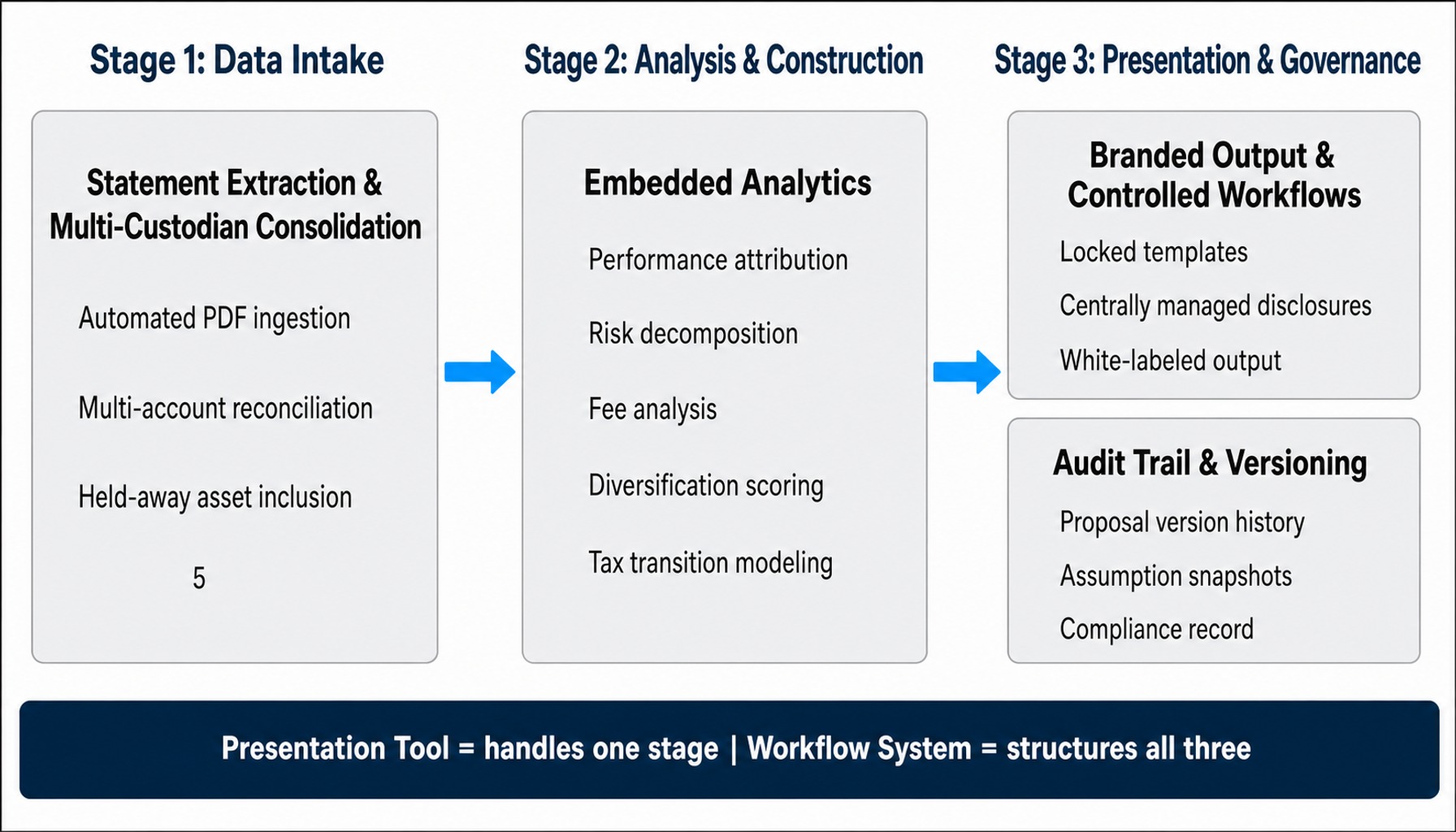
Five capabilities across three stages help define investment proposal software architecture.
The Multi-Custodian Problem Most Evaluations Underweight
Firms working across multiple custodians face a different proposal challenge than single-custodian shops, and this difference often carries architectural weight for household-level proposal generation, sleeve-level allocation mapping, and client transition building. The distinction that matters is between a platform that accepts data from multiple sources and one that normalizes it.
Platforms can differ in how they normalize multi-custodian data, including how classifications are mapped across sources. Some reporting-focused platforms handle multi-custodian aggregation well at the reporting level, but proposal-workflow aggregation is a separate capability. During demos, firms may benefit from testing multi-account structures rather than relying only on single-account examples.
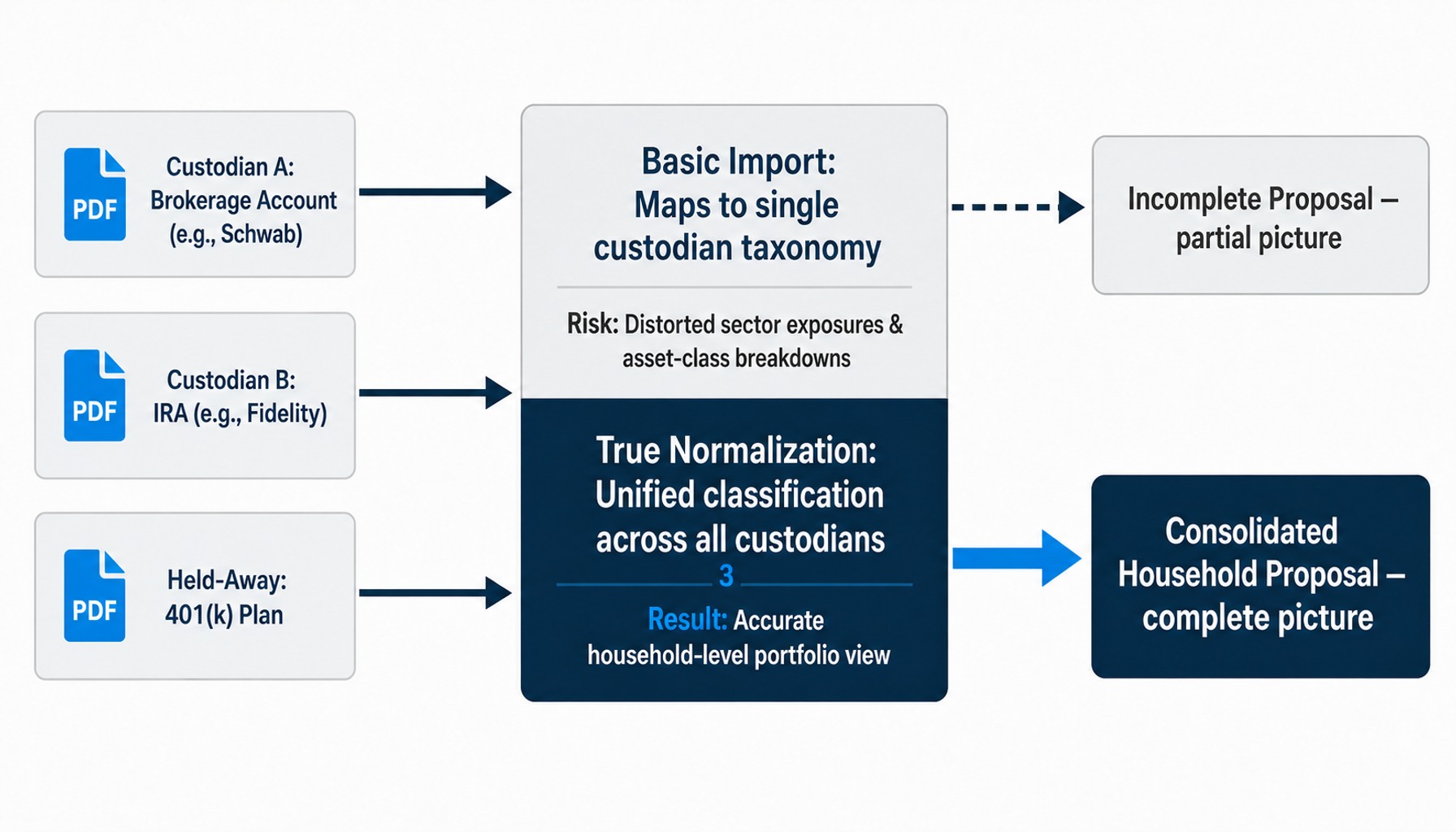
Multi-custodian normalization supports more consistent aggregation across accounts.
Compliance and Governance: Architecture, Not a Feature Checkbox
Compliance capabilities are often evaluated as a binary: does the platform have them or not? The more useful question is whether compliance is embedded in the workflow architecture or layered on top as a final review step. That distinction can shape whether governance supports scale or becomes a recurring bottleneck.
Template-Level Controls and Disclosure Management
One of the more operationally significant compliance capabilities is template-level control, the ability to lock proposal templates so that required disclosures, approved language, and firm-mandated sections are maintained consistently across advisors.
Imagine your firm updates its ADV Part 2 brochure and needs every proposal generated after today to include the new disclosure. In a platform without template-level governance, this may require a firmwide email, reliance on manual advisor follow-through, and periodic spot checks. In a platform with locked templates and centrally managed disclosures, the compliance team can make the change once and apply it consistently to future proposals. This approach may reduce risk exposure without requiring compliance to review every deliverable manually.
Audit Trails and Proposal Versioning
A defensible audit trail can support both internal governance and quality control, particularly when a firm needs to reconstruct which assumptions, models, and data snapshots were active when a specific proposal was generated.
From a buyer's perspective, the operational question is whether the platform preserves a clear record of what changed, when it changed, and which version was ultimately presented. When proposal versioning and auditability are built into the workflow, firms may find it easier to review past decisions, respond to internal oversight requests, and understand how a client-facing deliverable was assembled. That kind of recordkeeping can support more consistent operations, especially as teams, reviewers, and approval steps grow.
How Firm Size and Structure Can Change What You Prioritize
A solo RIA managing 80 households and a 50-advisor enterprise firm are not evaluating the same product category, even when they search for the same keywords. Their priorities are often different.
The solo advisor's primary goal is to find a repeatable path from data intake to client-ready presentation that may reduce preparation time. This practitioner is likely toggling between a CRM, a planning tool, and a risk-tolerance tool. They need proposal automation software that consolidates work, not another tab to keep open. For them, speed, data automation, and high-quality output may matter most, while complex, role-based permissions are often less relevant when one person controls the workflow.
In contrast, the enterprise firm's priority is firmwide consistency. The CIO may want to ensure advisors are using approved models from the firm's library. The CCO may need locked templates and auditable disclosure delivery. The managing partner may want a unified view of pipeline activity across teams and offices, what amounts to stronger operational visibility across the practice. Speed still matters, but governance, scalability, and visibility often carry more weight. Enterprise-TAMP platforms are often built for this kind of workflow, though firms may want to evaluate whether that architecture provides the right balance of control and advisor flexibility. The right platform should support all three stakeholders without forcing them into separate systems.
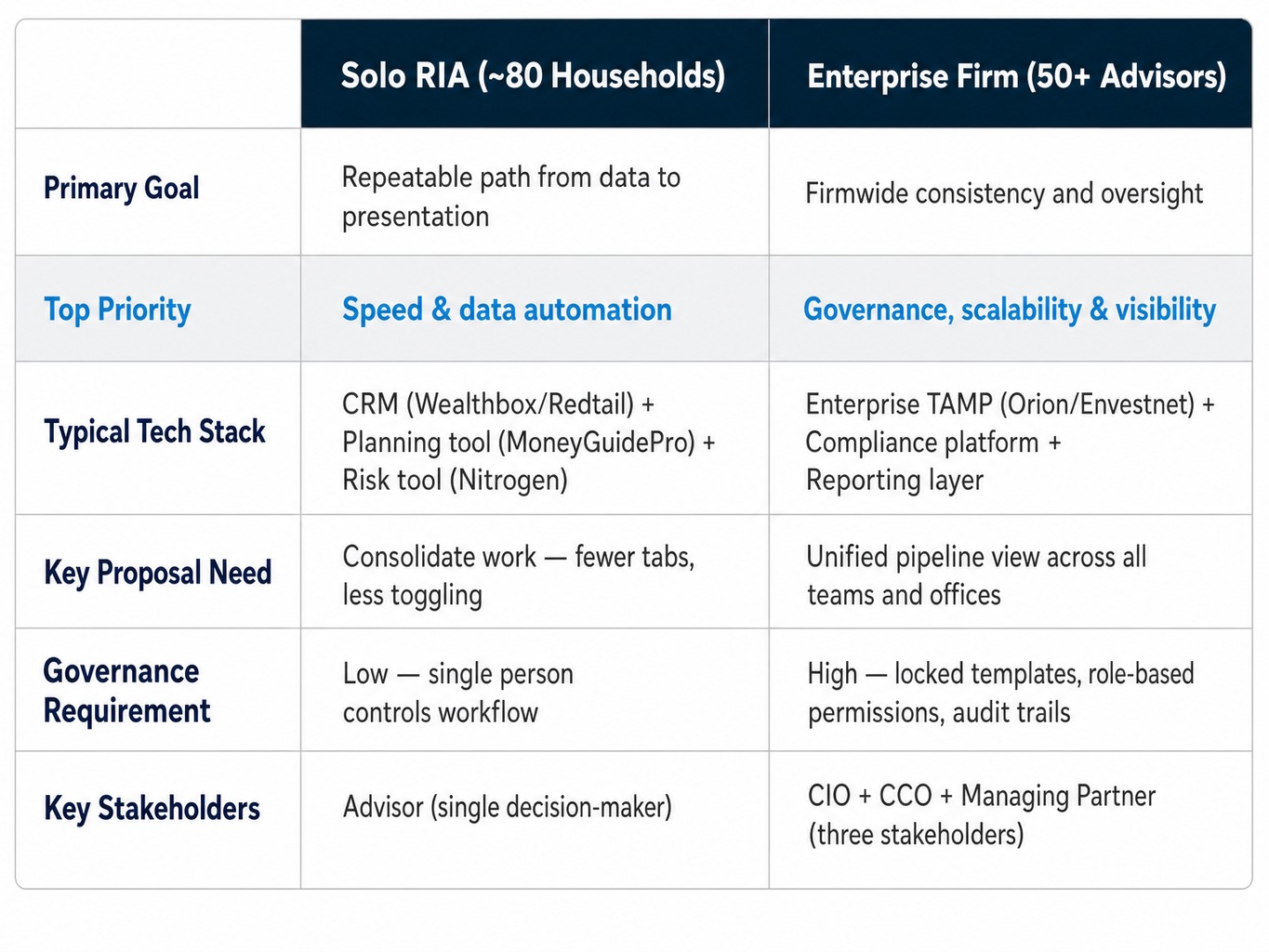
Firm size and structure can shape how firms evaluate proposal generation software.
How VRGL Approaches the Proposal Workflow as a System of Work
This workflow-first philosophy is how we approach the problem at VRGL. We do not see proposal generation as a standalone output category. We see it as one part of a broader acquisition workflow that connects data intake, analysis, recommendation support, presentation, and governance.
That broader view matters because many of the breakdowns firms encounter do not start at the proposal document itself. They start earlier, when data has to be re-keyed, analytics live in a separate tool, or teams lack a consistent way to govern what reaches a prospect. Proposal generation may be the visible moment in the process, but the operational challenge is usually the workflow around it.
Our perspective at VRGL is shaped by that larger category story. Rather than treating wealth management proposal software as an isolated endpoint, we focus on the system of work behind the proposal and the surrounding acquisition process. The goal is to help firms connect the steps that lead to a client-ready deliverable, with more consistency and less friction across teams.
For independent advisors , that can support a more repeatable path from statements to insights to client-ready presentations. For enterprise firms , it can support firmwide consistency and governance without dictating how individual advisors advise.
See how VRGL supports the acquisition workflow behind client-ready proposals request a demo.
From Feature List to Workflow Architecture
A more useful shift in evaluating wealth management proposal software is moving from feature comparison to workflow architecture. The better question is often not which platform has the longest feature list, but how well it supports the path from client data to a governed, client-ready deliverable, and how that proposal process fits into the broader acquisition workflow. Firms that evaluate proposal technology as part of a larger system of work may be better positioned to improve consistency over time.
This article is for informational purposes only and does not constitute investment, legal, or compliance advice. Financial advisory firms should consult with qualified compliance and legal professionals when evaluating platform capabilities against their regulatory obligations.
Frequently Asked Questions
1. What is the difference between a TAMP proposal tool and standalone wealth management proposal software?
A TAMP proposal tool may be designed to generate proposals using models available within the TAMP's ecosystem. Standalone or platform-agnostic wealth management proposal software is generally built to analyze a wider range of portfolios and support proposal construction across different custodians or model sources.
2. Can proposal software auto-generate an investment policy statement from discovery data?
Some platforms can populate IPS templates with data captured during the discovery and risk-tolerance process, but the advisor remains responsible for reviewing, customizing, and approving the final document. Firms should evaluate whether the platform connects its risk questionnaire output directly to IPS generation or requires manual data transfer.
3. What are the hidden costs of switching investment proposal generation platforms?
Beyond licensing fees, costs may include data migration, rebuilding branded templates with current disclosures, advisor retraining, and temporary productivity loss during transition. Firms may benefit from confirming that historical proposal archives can be exported in a usable format from the outgoing platform before committing.
4. Does proposal software support household-level and entity-level account structures?
Not all platforms handle this natively. Some generate proposals at the individual account level, requiring manual grouping for a household or entity view. During evaluation, firms should test whether the platform can consolidate multiple accounts across custodians and registration types into a single, coherent household-level proposal.